




Gartner Magic Quadrant 2026: BI Beyond Dashboards!
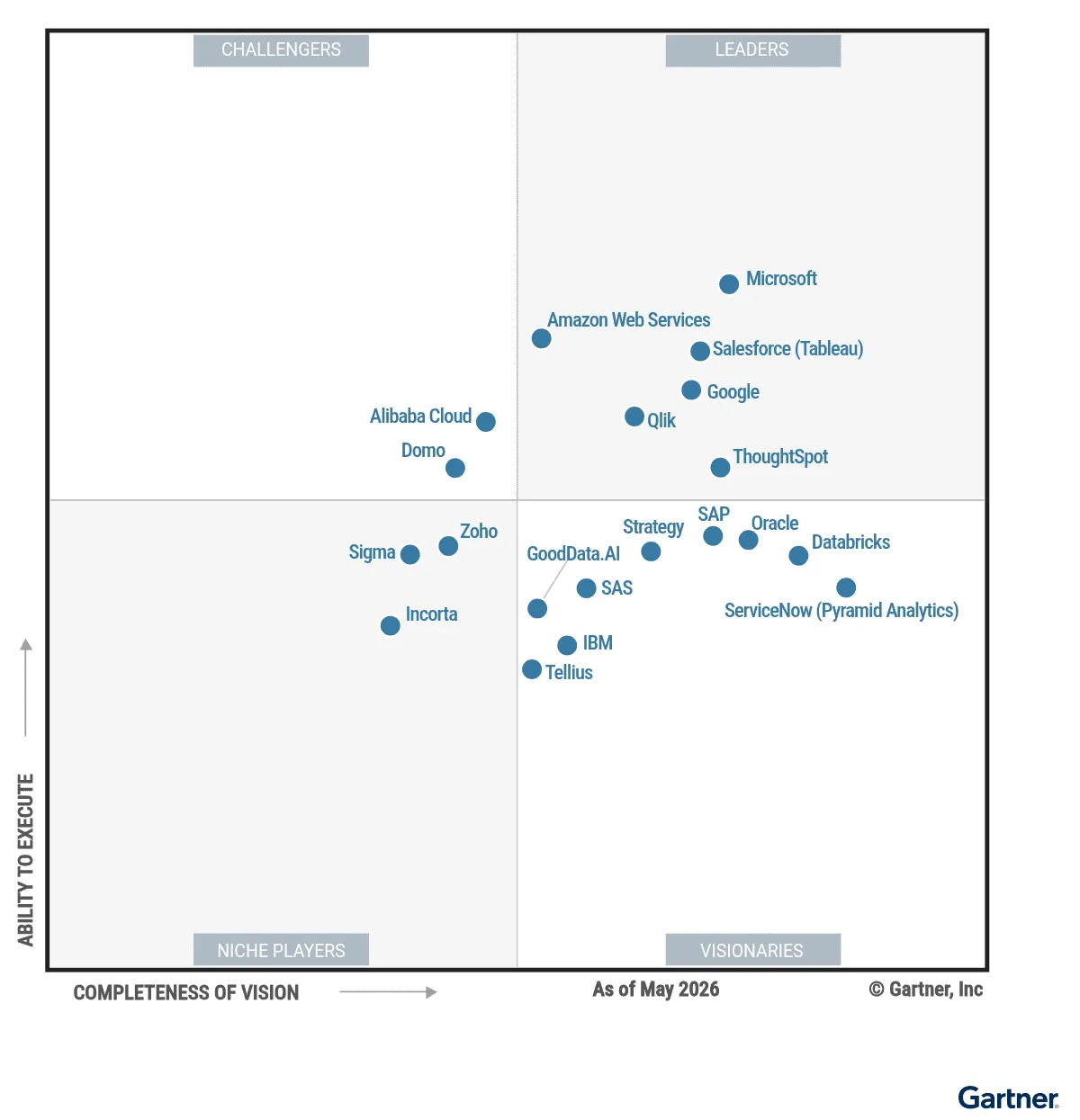
Gartner Magic Quadrant for Analytics and BI Platforms it’s the annual benchmark that evaluates the market’s leading analytics vendors. And this year, it confirms a shift we’ve been seeing on the ground: an analytics platform is no longer defined by its ability to build dashboards or distribute reports.
It’s now measured by its ability to give AI agents the context and control they need, agents that no longer just answer questions, but recommend, decide, and execute.
The report itself highlights the forces behind this shift:
Governance, once focused mainly on data and models, now extends to the automated decisions made by AI agents — decisions that must be explainable and auditable.
The rise of real‑time intelligence allows analytics to move beyond hindsight and support decisions at the exact moment data happens.
And technologies like semantic layers and ontologies are becoming essential to ensure AI responses are consistent and reliable, not just plausible.
In short, the opportunity lies in turning BI into a governed foundation that accelerates decision‑making. The risk lies in automating on top of data, metrics, and processes that are still fragmented.
Microsoft and Qlik appear as leaders, each with a distinct approach: one more tightly integrated within a broader technology ecosystem; the other more open and associative, designed for heterogeneous data environments.
In the projects we support, this choice is rarely decided by features alone. It’s driven by the architecture a company already has, and by the ambition it has for AI. An organization heavily invested in Azure and Microsoft 365 tends to gain more from Power BI and Fabric, simplifying an architecture that already exists. An organization operating across multiple clouds, legacy systems, or with a strong need to explore data without predefined paths often finds Qlik to be the more flexible answer.
Microsoft Power BI: integration as a core advantage
Power BI’s strength lies in its market presence and its native integration with Teams and Excel, which accelerates adoption. With Microsoft Fabric, it brings data engineering, storage, Business Intelligence, and AI together in a single platform.
Strengths:
Integration with the Microsoft ecosystem, making adoption easier for organizations already working with Azure, Microsoft 365, Teams, and Excel.
A broad community of users, partners, and certified professionals, making it easier to access skills and support.
An integrated platform where data, analytics, real‑time intelligence, and AI can evolve in a coordinated way.
A strategy focused on giving AI more context, powered by Fabric, OneLake, and the evolution of semantic models.
Cautions:
The greater the dependency on Fabric, the more costs, architecture, and the evolution of Power BI become tied to the platform’s capacity.
The use of AI features like Copilot requires close monitoring to avoid impacts on performance and cost predictability.
The ease of creating workspaces, dashboards, and reports can lead to duplicated content and inconsistent metrics. Without lifecycle policies, ownership, and certification, trust in the data degrades quickly.
Qlik: associative exploration as a strategic advantage
Qlik stands out for its associative engine, which allows users to explore data without predefined query paths. This capability is valuable both for human users and for AI agents that need to discover relationships, identify exceptions, and validate responses.
The platform combines conversational analytics, automation, and forecasting, with the flexibility to operate in the cloud, on‑premises, or in hybrid environments.
Strengths:
Associative exploration, allowing users to analyze relationships between data without being limited by filters or predefined analytical paths.
The ability to unify conversational analytics, automation, and forecasting within a single, cohesive platform.
Flexibility to integrate diverse data sources and operate across cloud, hybrid, or on‑premises environments.
A data‑driven AI approach designed for both structured and unstructured information, with the ability to support responses, alerts, and actions.
Cautions:
In consolidation strategies driven by one hyperscaler, Qlik’s absence of a native cloud ecosystem can limit its positioning.
Organizations adopting a direct‑query lakehouse strategy should evaluate how the in‑memory layer affects data duplication, caching behavior, and ingestion pipelines.
The freedom to choose among multiple language models requires clear governance over which models are used, with what data, and under which rules.
The platform is neither the problem nor the solution!
Gartner Magic Quadrant is neither a ranking table nor a buying recommendation. The right question isn’t "which platform is the best?", but "which platform fits our architecture, skills, and AI ambition?"
In every scenario, it’s the quality of the data, the definition of metrics, whether revenue, margin, customer service, or any other critical indicator, and the semantic layer that determine whether decisions truly become faster, or merely more automated.
We work with organizations to assess the right platform, implement Power BI, Microsoft Fabric, and Qlik Cloud, and create the semantic and governance discipline that turns data into a dependable asset for people and AI.
Want to understand which architecture makes the most sense for your organization? Book a 30‑minute conversation with our team..